better than make-do and mend
a symposium Friday May 15 & Saturday May 16
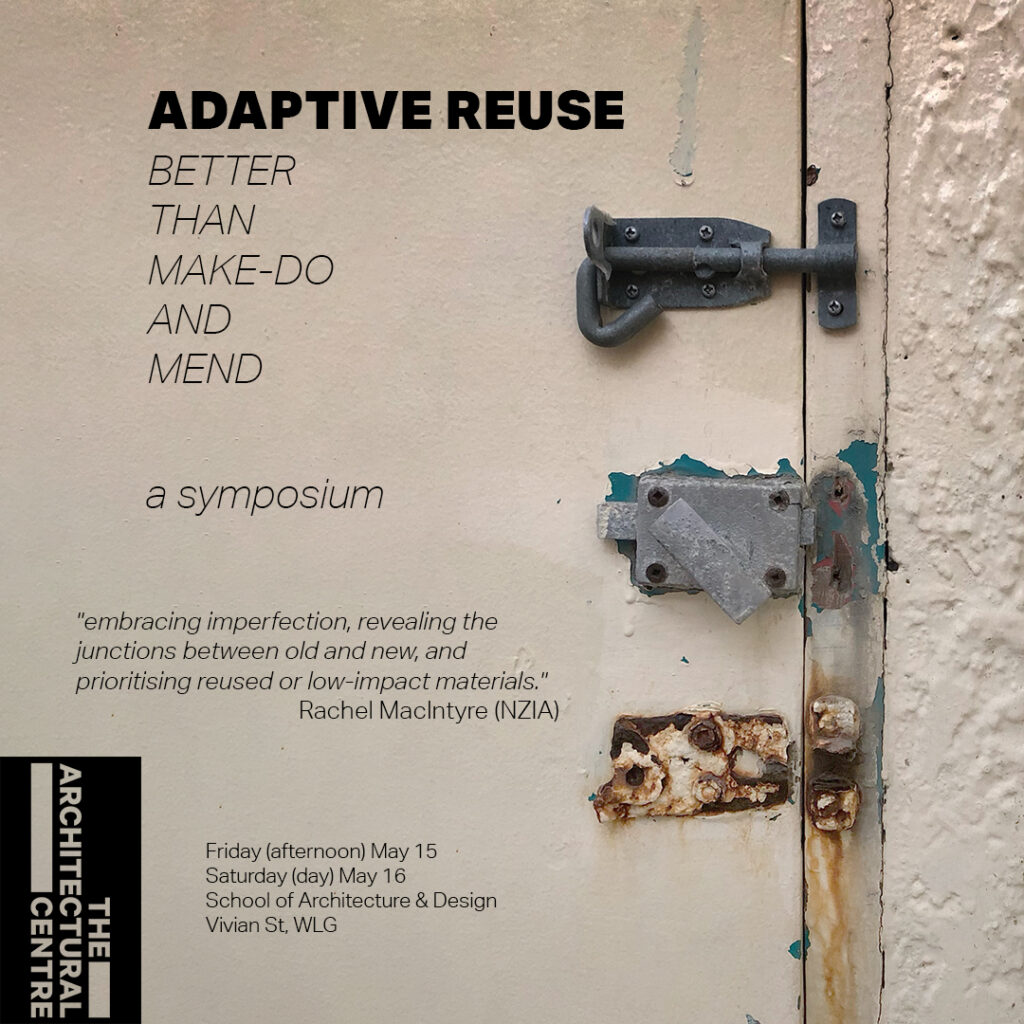
This symposium responds to Rachel MacIntyre’s essay The Architect as repairer: the retrofit imperative. Focusing on her suggestion that “a cultural shift among architects” is required, “embracing imperfection, revealing the junctions between old and new, and prioritising reused or low-impact materials.”
Our symposium asks, ‘when does adaptive reuse produce better architecture than building new?’ countering assumptions that mending a building is just making-do with what we already have, and that retrofit is merely a concession to energy, carbon &/or economic austerity.
We are leaving the definition of ‘better architecture’ deliberately broad because this is where we hope discussion will emerge. Implicitly we are suggesting that reuse and retrofit provides greater potential for things like:
- continuity in urban space while promoting an enrichment of urban experience
- spatial and material diversity by mixing existing and new building elements
- inventiveness, because the complexity of retrofit can challenge the design response.
The symposium will combine recent research, theoretical case studies and built examples to facilitate critical and open-ended discussion. Full attendance at the symposium is eligible for 75 CPD points, or see schedule for per-session allocations. Registration for CPD points will be taken during the events.
With thanks to our sponsors & supporters:
- SaveBoard
- Te Kura Waihanga ~ School of Architecture, Te Herenga Waka ~ Victoria University of Wellington
- Te Kāhu Whaihanga ~ New Zealand Institute of Architects.
Schedule
Friday May 15
3:30 to 5:30pm _ Opening Panel [20 CPD points]
- Rachel MacIntyre (NZIA)
- Athfield Architects
- Rachel Paschoalin (Victoria University of Wellington)
Saturday May 16
9:30 to 11:30am _ Adapting (late) Modernism [20 CPD points]
_ Vignettes
- Phillip Molter on Regensburg Public Housing (1967/2024, Germany)
- Bart Akkerhuis tbc.
_ The Case for Gordon Wilson Flats
The Gordon Wilson Flats were completed in 1959 and occupied until 2012. The final example of a series of housing innovations by the Office of the Government Architect, the decision to demolish the building was written into the Resources Management Amendment Act, 2025, as ‘section 85AAA.’
- Rob Tse (on line) – presenting design proposal developed as part of the Centre’s preservation advocacy.
- Francisco Carbajal (on line) – discussing carbon assessment processes relating to the preservation plan.
- Ken Davis – from writing the first history of Gordon Wilson up to his new research, Ken will provide an overview of the context of this building and just why the Centre has been concerned by its loss.
12:00 to 1:40pm _ Collage City [15 CPD points]
_ Vignettes: city cultures
- Rob Tse on La Valletta City Gate (mixed/2009-2015, Malta) by Renzo Piano Building Workshop.
- Jasmax on B201 (c.1970/2023, Auckland)
In riposte to Modern city planning ideals Colin Rowe and Fred Koetter coined the term ‘collage city’ (1978) to describe an urbanism where old and new buildings could be held in dynamic contrast. Today we might think in terms of sustainability enacted through adaptation, and diversity that supports resilience.
- Cansu Inal Kaynar – discussing enhancing sustainability and resilience through heritage buildings – the case of Whanganui.
- Lis Cowey – discussing her experience of Lina Bo Bardi’s SESC Pompeia, Sao Paulo.
- Foundation Architects – Arindam Sen – discussing the Meownui project
2:00 to 3:00pm _ The Case of 84 Taranaki Street [10 CPD points]
Built by the Winston Concrete Company in the late 1960s, this building was empty for many years before the Film Archive moved in and adapted it to create archive facilities and public facing venues. This presentation will discuss the process from the perspective of both client and architect/
- Frank Stark – ‘the client’
- Ken Davis – ‘the architect’
3:30 – 5:30pm _ propose and debate [10 CPD points]
This session will start with a quiz.
A student’s provocation will then direct discussion of the vignettes (5-10 min films profiling local and international projects) shown throughout the day.
There is a single EventBrite booking for this event. Please send an email after booking if you plan to also, or only, attend on Saturday. This is for catering purposes.
The event is being run on koha.
If you are in a position to financially support please help us out by making a direct payment to AC accounts (eg. $10 per day for catering), or consider joining/renewing you membership.
Account details:
06-0501-0160299-00
THE ARCHITECTURAL CENTRE INC


Leave a Reply to Deb cranko Cancel reply